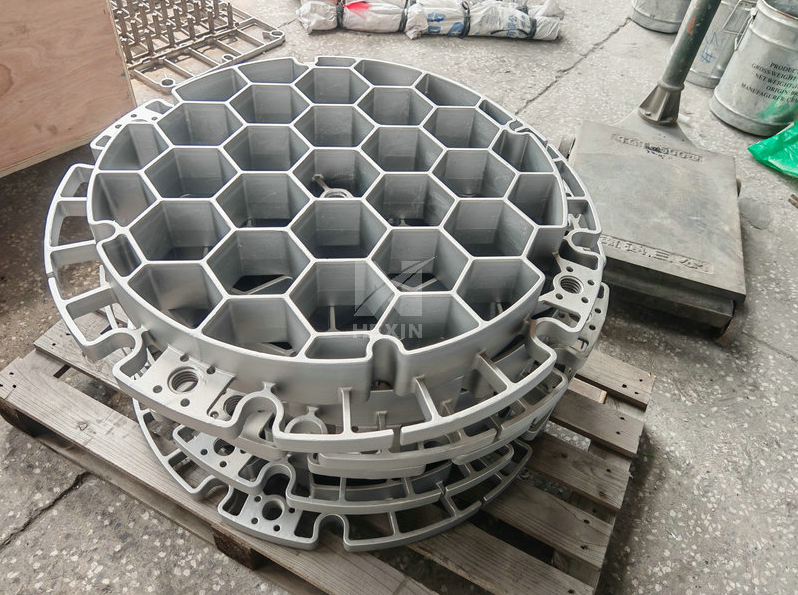
Advantages of 1.4848 Heat-Resistant Steel for Industrial Fixture
Advantages of 1.4848 Heat-Resistant Steel for Industrial Fixture
1.4848 is the most versatile, general-purpose heat-resistant cast steel. It is ideally suited for environments involving air or oxidizing atmospheres, operating temperatures in the 850–1050°C range, and applications requiring large quantities of standardized Fixture, cost-sensitivity, or frequent repairs.
Performance Advantages
1. High-Temperature Oxidation Resistance: With a chromium content of 24–27%, 1.4848 forms a dense, stable Cr₂O₃ oxide layer on its surface. This scale is resistant to spalling and does not contaminate the workpieces; in furnaces operating continuously in oxidizing atmospheres, 1.4848 proves to be exceptionally durable.
2. Resistance to Sulfidation/Sulfur-Bearing Atmospheres: The 25% chromium content provides excellent resistance to sulfidation, while the 20% nickel content stabilizes the austenite phase and inhibits embrittlement caused by the sigma (σ) phase. In sulfur-containing combustion gas environments, high-chromium/low-nickel alloys outperform high-nickel alternatives—a significant advantage for Fixture used in gas-fired furnaces and incinerators.
3. Cost-Effectiveness: Nickel is the most expensive element in heat-resistant steel. 1.4848 contains only about half the nickel found in 1.4849, offering a clear advantage in raw material costs. In the industry, high-nickel grades (such as the HP-Nb series) typically carry an initial cost 25–30% higher than HK40, and often require more specialized casting processes. For large-scale, standardized Fixture, the savings per unit are substantial.
4. Ease of Casting and Welding: The lower nickel content reduces the tendency for hot cracking and segregation, while providing excellent castability—making it well-suited for the integral casting of large, complex-shaped components (such as heat-treatment baskets). Furthermore, repairs can be performed using standard 25-20 welding consumables, keeping maintenance requirements simple and accessible. 5. Supply Maturity and Standardization: 1.4848 (HK40) is the most widely used general-purpose heat-resistant cast steel grade globally. It complies with multiple standards—including EN 10295, ASTM A297, and GB/T 8492—ensuring a broad supplier base, easy availability of replacement parts, and transparent pricing; these are highly practical advantages for industrial procurement.
6. Room-Temperature Strength and Toughness: With an ultimate tensile strength (Rm) of ≥450 MPa and an elongation of ≥8% (compared to ≥420 MPa and ≥4% for 1.4849), this material is resistant to deformation or fracture from knocks and impacts during handling, loading, unloading, or lifting, resulting in superior structural integrity.7. A “High-Spec” Option within Its Family: Belonging to the 25Cr-20Ni alloy series, 1.4848 is a cast grade with a higher carbon content (0.3–0.5%). It offers significantly better high-temperature strength, creep resistance, and oxidation resistance than rolled 310S/1.4845 plate. Consequently, for applications such as furnace hearth plates or material trays, 1.4848 castings serve as a more durable alternative to 310S.